
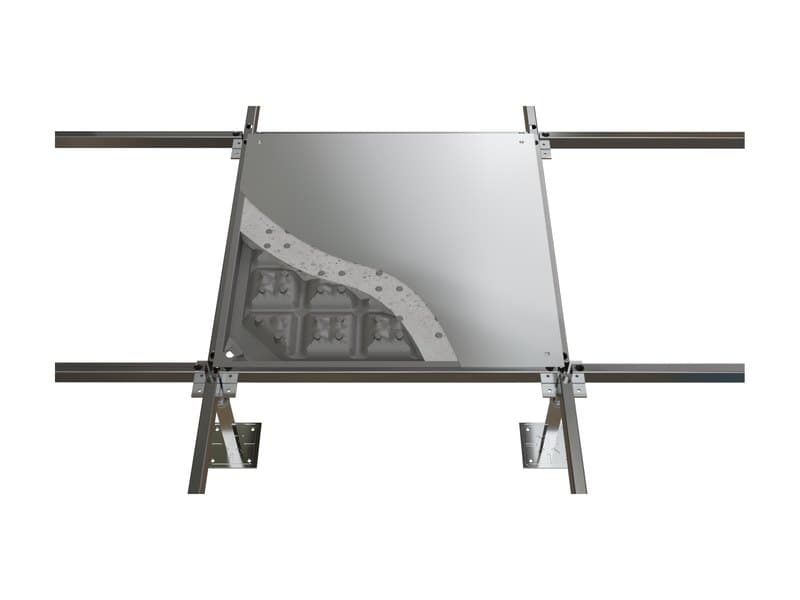
Most office buildings deliver air from the ceiling through a network of ducts and ceiling diffusers. Underfloor air distribution (UFAD) turns that upside down. Conditioned air goes into the space under a raised access floor, and floor diffusers set into the panels deliver it straight into the occupied zone. The air rises as it picks up heat and is returned at the ceiling.
This guide explains how a pressurized underfloor plenum works, what the diffusers do, where the benefits come from, and what the architect, mechanical engineer and floor installer need to coordinate. Facts are attributed to the named sources listed at the end. The mechanical engineer of record designs the HVAC system; LG2 supplies and installs the Tate floor.
How a pressurized underfloor plenum works
In a UFAD system, supply air is filtered and conditioned by a conventional air handler, then passed through a minimum amount of ductwork into the underfloor plenum formed by the raised floor, according to the DOE Federal Energy Management Program (FEMP) technology review. That review notes the plenum is typically formed by 2 ft × 2 ft concrete-filled steel panels set 12 to 18 in. above the structural slab, with power and communication cabling in the same space.
The FEMP review describes two approaches. Passive diffusers require a pressurized plenum: the air handler keeps the plenum at a slight positive pressure, and that pressure pushes air up through the diffusers. Systems built entirely on fan-assisted active diffusers typically use a zero-pressure plenum instead. The review reports that the majority of UFAD systems being deployed use pressurized plenums.
A note on terms: diffusers and air towers
The devices in the floor that deliver air to the room are floor diffusers (sometimes called air terminals or outlets). Tate's product literature lists passive diffusers, automatic VAV diffusers and the Tate swirl diffuser for this job. Tate's older product guide also lists an Air Tower Unit, but it describes it as a unit that quietly supplies air to the underfloor plenum, not as a room outlet. So in Tate's terms, an air tower feeds the plenum and diffusers deliver the air to people.
Floor diffusers and swirl diffusers
The FEMP review lists six diffuser types in use: fan-assisted active, variable area active, swirl passive, swirl active, linear bar grille passive and linear bar grille active. Interior zones generally have diffusers near occupants, within or close to workstations.
Tate's swirl diffuser is a modular device that mounts into an access floor panel and "plugs" into the underfloor air space. Per Tate's data sheet, it delivers conditioned air at floor level with a low-velocity helical discharge, lets the occupant control both the volume and direction of the air by turning the grille, and has a removable basket that catches dirt that falls through. Tate also notes the diffusers are not designed for rolling load traffic, which matters when choosing locations.
Much less overhead ductwork
Because the plenum itself distributes the air, UFAD eliminates much of the ductwork an overhead system runs across the ceiling. Tate's underfloor service distribution white paper says UFAD eliminates the need for overhead ductwork, allowing exposed ceilings, and that underfloor service distribution can allow a reduction in slab-to-slab height. The FEMP review similarly notes that in new construction UFAD can lead to reduced floor-to-floor heights.
Lower fan energy and warmer supply air
Tate's white paper states that an underfloor HVAC system performs at a much lower pressure and a warmer supply temperature than a traditional ducted overhead system, and that lower system pressure helps energy efficiency through reduced mechanical equipment and longer economizer hours.
The FEMP review puts numbers on the supply side: because air enters the occupied zone directly, supply outlet temperatures are generally kept above 63 to 64°F (17 to 18°C) to avoid uncomfortably cool conditions near the floor. It attributes UFAD's energy benefits to two factors: cooling energy from economizer operation and higher chiller efficiency, and fan energy. It cites early indications of annual HVAC energy reductions in the range of 10 to 20%, depending on system design and weather, and cautions that a poorly designed or operated UFAD system can use more energy than a well-designed conventional one.
Thermal stratification and occupant control
UFAD relies on a floor-to-ceiling airflow pattern. Per the FEMP review, the air takes advantage of the natural buoyancy of heat sources in the room to carry heat and contaminants up and out, and is returned at ceiling level; the occupied zone extends up to about 6 ft. Tate's swirl diffuser literature describes the result as stratification, with lower concentrations of heat and pollutants in the lower part of the room than the upper part. CBE at UC Berkeley has developed a room air stratification model and a UFAD cooling load design tool for engineers.
Occupant control is the other half. The FEMP review notes individuals can adjust the volume and direction of the air entering their workstation, and that ASHRAE Standard 55 was revised to allow higher air velocities when the occupant controls local air speed. It also notes that in open-plan settings there is less control from opening and closing diffusers than in private offices.
Reconfiguring when the layout changes
Because diffusers live in the floor panels, moving air follows moving people. Tate's swirl diffuser can be relocated by swapping its floor panel with one in the new location, and Tate's white paper highlights easy diffuser reconfiguration as occupancy and layouts change, along with reuse of diffusers, cables and outlets. The same floor carries power and data, so a workstation move can take its air, power and data with it. For panel, understructure and finish choices, see Raised Access Floors: Panels, Understructure and Airflow Basics.
Design considerations
- Plenum height. The FEMP review cites typical floors 12 to 18 in. above the slab for UFAD. The mechanical engineer sets the plenum height the air system needs, and the finished floor height and understructure are then selected to suit it (see our raised access flooring page for Tate understructure options).
- Sealing and air leakage. Tate's Architect's Guide for Detailing and Specifying Access Floor Air Plenums calls plenum integrity one of the most important aspects of a UFAD system and says the process starts with the architect. It lists sealing locations such as the perimeter seam at the slab and exterior wall, plenum dividers and penetrations through them, cable cutouts, and pipe penetrations, and asks every trade working in the plenum to seal what it opens. Tate offers UFAD grommets designed to nearly eliminate leakage at panel openings, and AirArrest grommets for through-wall service distribution.
- Plenum heat gain. CBE notes that heat transfer into the supply plenum, from the slab and floor panels, can amount to a substantial portion of the total room cooling load, and its design tool accounts for it.
- Perimeter zones. The FEMP review describes perimeter heating and cooling handled by fan-powered terminal units in the plenum, with diffusers normally within about 15 ft of exterior walls.
- Moisture and spill-prone rooms. The FEMP review notes concern about improperly dehumidified air causing condensation on a cool slab, and lists bathrooms, laboratories, cafeterias and shop areas as places where access floors and UFAD are generally not appropriate.
- New work vs. retrofit. The FEMP review says UFAD's advantages are most easily achieved in new construction.
- Coordination. Bring the mechanical engineer, architect and floor installer together early on plenum height, zoning and plenum dividers, diffuser layout, sealing details and the finish. The ASHRAE UFAD Design Guide, developed with CBE and updated in 2013, is the engineer's reference.
Data center airflow panels such as Tate DirectAire, GrateAire and perforated panels also use the underfloor space as a supply plenum, but they are sized for equipment cooling rather than occupant comfort. Our raised access flooring page covers those panels.
How LG2 helps
LG2 supplies and installs Tate raised access floors throughout Michigan and Indiana from Grand Rapids. On UFAD projects we work with the mechanical engineer and architect on floor height, panel and understructure selection, plenum dividers, diffuser panel cutouts and sealing details, and we coordinate with the other trades working in the plenum. Contact LG2 with your drawings and floor requirements.
FAQ
Frequently asked questions
- Are "air towers" the same thing as floor diffusers?
- Not in Tate's terms. The devices in the floor that deliver air to the room are diffusers, such as Tate's passive, automatic VAV and swirl diffusers. Tate's product guide describes its Air Tower Unit as a unit that supplies air to the underfloor plenum.
- How high does a raised floor need to be for UFAD?
- The mechanical engineer sets it. The DOE/FEMP technology review cites typical UFAD floors 12 to 18 in. above the slab. LG2 then matches the Tate panel and understructure to that finished floor height.
- Can floor diffusers be moved later?
- Yes. A Tate swirl diffuser is installed in a floor panel, so it can be moved by swapping that panel with one in the new location. Keep diffusers out of rolling load paths, since Tate notes they are not designed for rolling loads.
Sources
- Underfloor Service Distribution Whitepaper. Tate Global.
- Tate Swirl Diffuser data sheet. Tate Access Floors. Hosted by a distributor.
- Access Floor Solutions product guide (rev. 2011). Tate Access Floors. Underfloor air devices, Air Tower Unit, plenum dividers and AirArrest grommets. Hosted by a Tate dealer.
- Agile and Sustainable product guide (swirl diffuser and UFAD grommets). Tate Access Floors.
- Architect's Guide for Detailing & Specifying Access Floor Air Plenums. Tate Access Floors.
- Alternative Air Conditioning Technologies: Underfloor Air Distribution (UFAD), Technology Installation Review. U.S. DOE Federal Energy Management Program; T. Webster, Center for the Built Environment, UC Berkeley (LBNL-49527, March 2004).
- Underfloor Air Distribution (UFAD) Design Guidance. Center for the Built Environment (CBE), UC Berkeley, with ASHRAE (RP-1064).
- UFAD Cooling Load Design Tool. Center for the Built Environment (CBE), UC Berkeley.