
A natatorium locker room may be the hardest room in a building on lockers. The air is warm and humid all day, floors and benches stay wet, swimmers drip on everything, and the air above an indoor pool carries chlorine compounds. Lockers that are fine in a school corridor can rust, swell or start to smell here.
That's why most pool, shower and aquatic center locker rooms use solid HDPE plastic or solid phenolic lockers. This guide explains what makes these rooms hard on lockers, why the two materials hold up, what to specify for ventilation and hardware, and where metal, wood and laminate lockers fit instead. Manufacturer facts come from the published product information for the plastic and phenolic lines LG2 supplies and installs throughout Michigan and Indiana; pool-air facts are attributed to the sources listed at the end.
What makes pool and shower rooms hard on lockers
- Standing water and splash. Wet swimsuits, towels and feet put water on locker doors, bottoms and bases every day, and floors are hosed or mopped often.
- Constant humidity. Indoor pools keep the air warm and moist, so surfaces rarely dry out completely, and anything that absorbs water stays damp.
- Chlorine compounds in the air. According to CDC, chlorine that binds with what swimmers bring into the pool forms chloramines, which off-gas into the air above the water and build up indoors without enough fresh air. An ASHRAE Journal article on natatorium design notes that chloramine-polluted air is acidic and corrodes carbon and even stainless steel.
- Cleaning chemicals. Locker rooms are cleaned and disinfected often, so locker surfaces need to tolerate regular cleaning without breaking down.
- Mold, mildew and odor. Damp, warm rooms with organic material on surfaces are where mildew and odor grow.
A good wet-area locker answers all five: it can't rust, it doesn't absorb water, it shrugs off cleaning, and it lets air move so the contents and the locker dry out.
HDPE plastic lockers: solid, color-through and rustproof
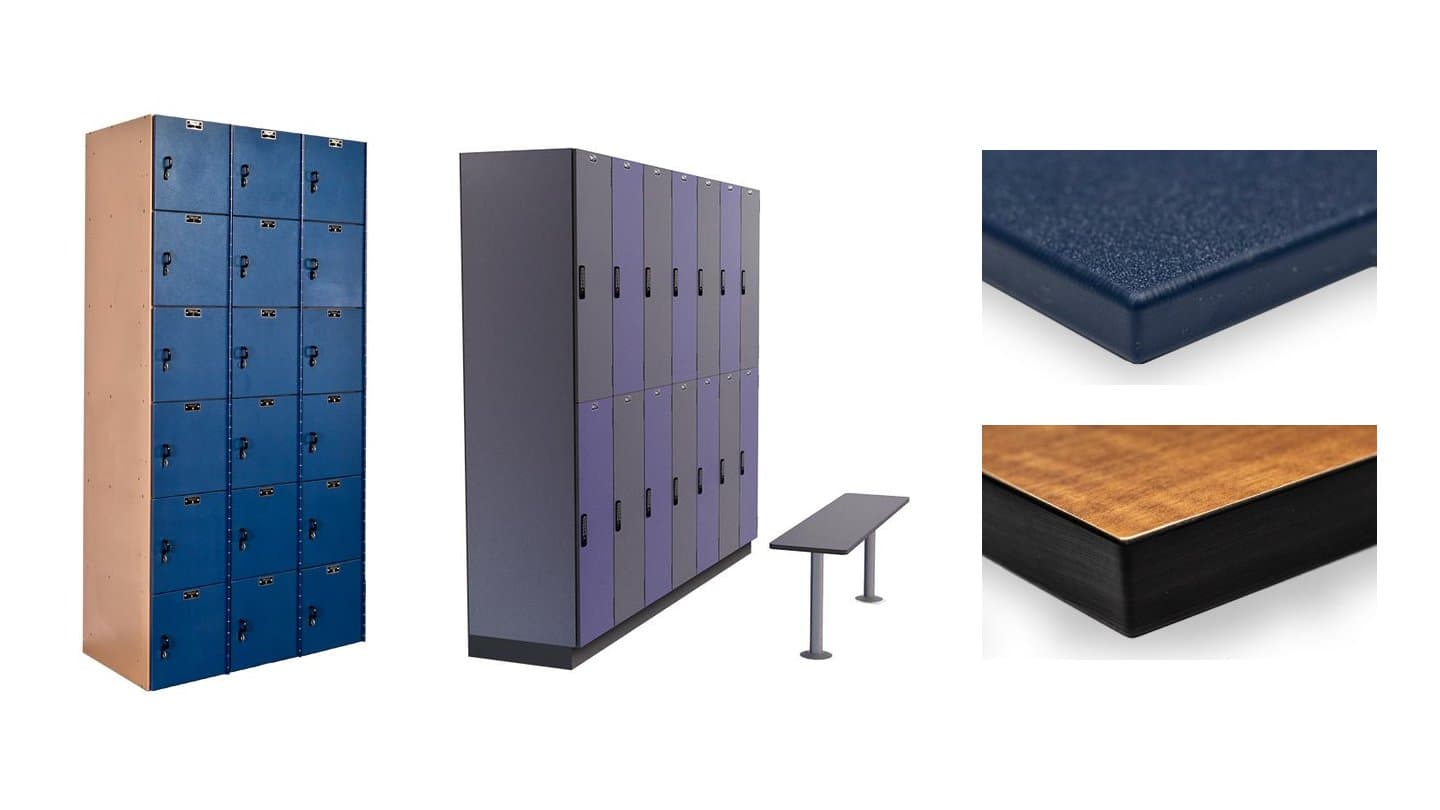
Solid plastic lockers are made from high density polyethylene (HDPE) panels, colored all the way through. There is no metal in the body to rust and no coating to chip, so a scratch shows the same color underneath. HDPE doesn't absorb water, and manufacturers build these lockers specifically for showers, pools, outdoor areas and other high-humidity rooms.
- No rust or corrosion: the body and doors are solid plastic. ASI Storage Solutions says its plastic lockers will never rust, rot, corrode or fade.
- Moisture and chemical resistance: List Industries lists its Aquamax HDPE lockers as resistant to scratches, corrosion, dents, mildew, graffiti and chemicals.
- Nothing to delaminate: HDPE is one solid material, not a face bonded to a core.
- Solid joinery: Columbia Lockers (PSISC) and Summit Lockers assemble HDPE lockers with mortise and tenon joints and stainless steel fasteners.
- Long warranties: 20 years on List Industries Aquamax and ASI plastic lockers, and 25 years on Columbia PolyLife.
LG2 supplies HDPE lockers from List Industries, Columbia Lockers (PSISC), Summit Lockers and ASI Storage Solutions in 1 to 6-tier and Z-tier configurations. Compare the lines, colors and sizes on our plastic lockers page.
Solid phenolic lockers: waterproof, with a wood-look option
Solid phenolic lockers are made from resin-impregnated layers formed into a solid panel under heat and pressure (Columbia Lockers cites over 1,000 psi near 300°F). The panel is non-porous and waterproof all the way through, so there is no wood core for water to reach and nothing to swell.
- Waterproof and non-porous: List Industries describes VersaMax solid phenolic as waterproof material that prevents mold, mildew and bacteria.
- No delamination or rust: Columbia says its solid core phenolic won't delaminate, rust or corrode, and recommends it for aquatic facilities, rec centers, schools, stadiums and healthcare.
- Chemical resistance: Columbia lists resistance to chemicals, wear, scratches and graffiti, and ASI describes its phenolic as impact, water and corrosion resistant.
- A wood look in a wet room: phenolic comes in solid colors, speckles and woodgrains, so a pool or spa locker room can look warm without real wood.
- Long warranties: 20 years on List Industries VersaMax and ASI phenolic lockers, and 25 years on Columbia phenolic.
LG2 supplies solid phenolic lockers from List Industries, Columbia Lockers (PSISC), Summit Lockers and ASI Storage Solutions. See sizes, finishes and locks on our phenolic lockers page.
How locker materials compare in a wet room
| HDPE plastic | Solid phenolic | Powder-coated steel | Wood and laminate | |
|---|---|---|---|---|
| Body material | Solid HDPE, color-through | Solid phenolic panel | Steel with a painted or powder-coated finish | Wood, or a laminate face over an engineered wood core |
| Rust and corrosion | Can't rust | Can't rust | Protected by its coating; bare steel at scratches or worn edges can rust | No rust, but metal hardware still needs protection |
| Standing water | Doesn't absorb water | Waterproof, non-porous | Water sits on seams, edges and bottoms | Wood and wood cores can absorb water and swell |
| Delamination | Nothing to delaminate | Solid core; Columbia says it won't delaminate | Not applicable | Laminate faces and edge banding depend on staying dry |
| Best place in an aquatic facility | Showers, pool decks, wet locker rooms | Wet locker rooms, aquatic and spa dressing rooms | Dry corridors, offices and gym rooms | Dry dressing areas, clubs and offices |
Ventilation: inside the locker and in the room
Wet towels and swimsuits shut in a sealed box will smell, whatever the locker is made of. Wet-area lockers are built to move air:
- Perimeter ventilation around the doors, on List Industries Aquamax and VersaMax and ASI phenolic lockers.
- Vertical ventilation holes in tops, shelves and bottoms, plus hidden perimeter ventilation around full overlay doors, on Summit HDPE lockers.
- Slotted or lattice ventilation options on ASI plastic lockers.
Locker ventilation only works if the room air is right. CDC advises moving fresh air across the pool surface toward exhaust vents and exhausting chloramine-polluted air outdoors, and the Model Aquatic Health Code describes the air handling system's job as preventing condensation, corrosion and stratification. The mechanical engineer designs that system; on our side, we coordinate locker placement so the lockers don't block supply or return air.
Stainless and non-corrosive hardware
A plastic or phenolic body won't rust, but hinges, fasteners, hooks, handles and locks can. In a pool locker room, ask what every metal part is made of:
- Fasteners: Columbia Lockers (PSISC), Summit Lockers and ASI Storage Solutions assemble their lockers with stainless steel fasteners.
- Hinges: List Industries VersaMax uses stainless 5-knuckle hinges, Aquamax uses a continuous extruded aluminum hinge, and Columbia offers aluminum and stainless hinges.
- Handles and latches: Aquamax wardrobe lockers use a projecting solid plastic lift handle, and Columbia offers antimicrobial handles on PolyLife.
- Locks: depending on the line, padlock hasps, built-in combination, key, card and digital keypad locks are available. Ask whether a lock model is meant for wet areas before you specify it.
Stainless isn't invincible
Stainless steel and aluminum hold up far better than plain steel in wet rooms, but the same ASHRAE Journal article notes that chloramine-laden air corrodes stainless steel too. Good room ventilation protects the hardware as much as it protects swimmers.
Easy cleaning and mold and mildew control
Because HDPE and phenolic are non-porous, water, soap residue and grime sit on the surface instead of soaking in, so they wipe off. List Industries lists Aquamax as easy to clean and mildew and odor resistant, and solid phenolic resists mold, mildew and bacteria. Our practical advice for keeping wet-area lockers fresh:
- Wipe down with a mild detergent and water, rinse, and let the lockers air dry with the doors open when the room is closed.
- Skip abrasive pads and powders, and use only the cleaners and disinfectants listed in each manufacturer's care guide. LG2 can provide the care guide for your lockers.
- Squeegee floors under and around the lockers and keep drains clear, so the bases aren't sitting in water.
- Ask users not to leave wet towels and suits in lockers overnight.
Where metal, wood and laminate lockers fit instead
Every material has a room it's best in. Metal, wood and laminate lockers are excellent choices; they're just less suited to rooms that stay wet.
- Metal lockers are the standard for school corridors, workplaces and dry gym rooms, where ventilated steel with perforated doors lets clothes air out. Steel depends on its painted or powder-coated finish for protection, so constant water and chlorine-laden air are hard on it. See metal lockers.
- Wood lockers bring a furniture look to country clubs, spas and team rooms. Their clear finishes resist moisture, but wood isn't meant for showers or pool decks. See wood lockers.
- Laminate lockers put a high pressure laminate face over an engineered wood core. They suit dry dressing areas, offices and clubs; inside shower rooms and on pool decks, solid phenolic or HDPE is the better fit. Some laminates now have antimicrobial, mold-resistant faces, which helps with hygiene, but the core behind the face is still wood-based. Manufacturers that build both laminate and phenolic lockers point to phenolic for wet, humid rooms such as pool houses and spas. See laminate lockers.
Many facilities mix materials: HDPE or phenolic lockers near the pool and showers, and wood, laminate or steel lockers in dry corridors and offices.
Planning a pool or natatorium locker room
- Map the wet zones: pool deck, showers, changing area and corridor. Put HDPE or phenolic where the lockers will get wet.
- Count users and choose tiers. Plastic and phenolic lines run from single tier for full-length hanging to six-tier and Z-tier for higher counts.
- Match the benches: Summit offers 1" HDPE and 3/4" phenolic benches, and LG2 can supply phenolic or HDPE locker room benches to go with any of these lines. Bench tops also come in solid surface, butcher block and vinyl cushion, on powder-coated or stainless steel legs. Near the pool and showers, choose HDPE, phenolic or solid surface tops on stainless legs, and keep butcher block and cushions in the dry areas.
- Plan ADA positions into the layout. Columbia offers ADA-compliant offset and aluminum uni-hinge options, and we confirm accessible locations with the design team during submittals.
- Name the hardware and locks in the spec, and confirm warranties for the exact line.
LG2 supplies and installs plastic and phenolic lockers for aquatic centers, school and university pools, rec centers and health clubs throughout Michigan and in Indiana. We prepare submittals with each manufacturer's specifications and coordinate delivery and installation. Compare all materials on our lockers page, or send us the floor plan and user counts.
FAQ
Frequently asked questions
- What are the best lockers for a pool or natatorium?
- Solid HDPE plastic or solid phenolic lockers. Neither can rust, both are non-porous so they don't absorb water, and both resist the cleaning chemicals used in locker rooms. List Industries, Columbia Lockers (PSISC), Summit Lockers and ASI Storage Solutions all make HDPE and phenolic lockers for pools, showers and wet locker rooms.
- Do plastic lockers rust?
- No. HDPE plastic lockers have solid plastic bodies and doors, colored all the way through, so there is no steel to rust and no coating to chip. Check that the hinges, fasteners and locks are stainless steel, aluminum or plastic too.
- Can phenolic lockers get wet?
- Yes. Solid phenolic is waterproof and non-porous all the way through, with no wood core, so it won't swell. Columbia says its solid core phenolic won't delaminate, rust or corrode, and recommends it for aquatic facilities.
- Should I choose plastic or phenolic lockers for a wet area?
- Both work. HDPE is solid, color-through plastic built for showers, pool decks and outdoor areas. Phenolic is a dense, waterproof panel that also comes in speckles and woodgrains, which many designers choose for spa and aquatic dressing rooms. Your room layout, look and budget usually decide it, and we can help compare lines.
- Why aren't metal lockers recommended near pools?
- Steel lockers rely on their paint or powder coat for protection. In a room that stays wet and has chloramines in the air, scratched or worn spots can rust over time. Metal lockers remain a great choice for dry corridors, offices and gym rooms.
- Does LG2 supply and install pool lockers in Michigan and Indiana?
- Yes. LG2 supplies and installs HDPE plastic and solid phenolic lockers for aquatic centers, school and university pools, rec centers and health clubs throughout Michigan and in Indiana, including Indianapolis, Fort Wayne and South Bend. Call Lucas Reimink, Project Manager & Estimator, at (616) 460-4024.
Sources
- Chloramines and Pool Operation. U.S. Centers for Disease Control and Prevention (CDC), Healthy Swimming.
- Model Aquatic Health Code, 4th Edition (2023), Code Language. U.S. Centers for Disease Control and Prevention (CDC). Definition of an air handling system.
- Natatoriums (pool ventilation design). ASHRAE Journal, July 2017. Hosted by an HVAC manufacturer.
- Published plastic and phenolic locker product information. List Industries, Columbia Lockers (PSISC), Summit Lockers and ASI Storage Solutions. As summarized on LG2's plastic and phenolic lockers pages.
- Laminate, phenolic and bench options in locker manufacturers' collection brochures. Manufacturer literature supplied to LG2. Used for the laminate, phenolic and bench notes. Brochures are listed on our Tech Data & Brochures page.