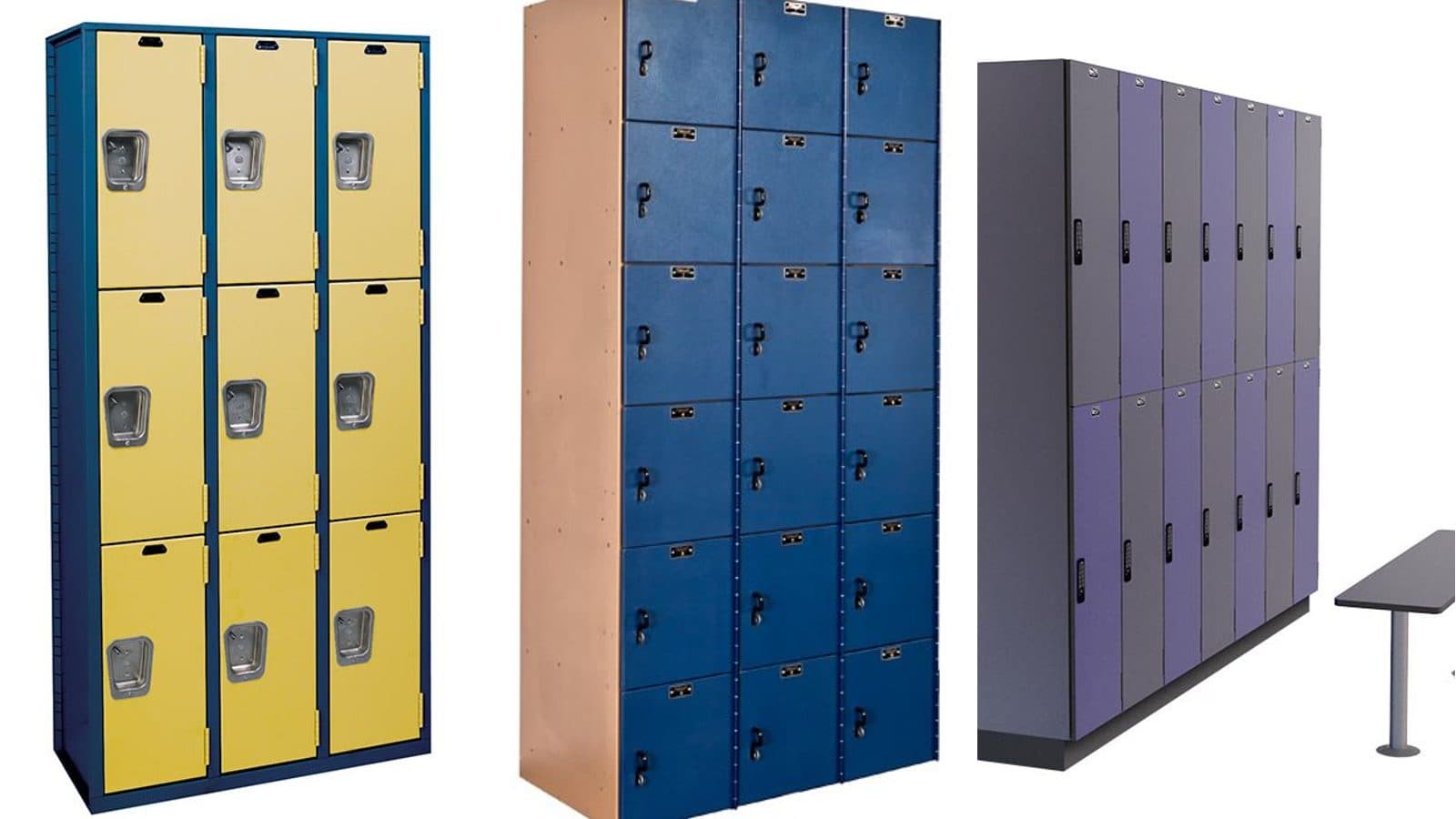
Metal, plastic and phenolic lockers can all look alike on a floor plan, but they behave very differently after ten years of slammed doors, wet towels and cleaning chemicals. The cheapest locker on bid day is not always the cheapest locker to own.
This guide compares powder-coated steel, solid HDPE plastic and solid phenolic lockers on the things owners and designers ask us about most: lifespan and warranty, durability, maintenance, moisture and corrosion, fire ratings, vandal resistance, ventilation, appearance, lead time and total cost of ownership. Manufacturer facts come from the published product information for the lines LG2 supplies: metal lockers from List Industries, and plastic and phenolic lockers from List Industries, Columbia Lockers (PSISC) and Summit Lockers. Industry sources are listed at the end.
The three materials in one minute
- Metal lockers are cold-rolled or galvannealed sheet steel, formed and finished with a baked powder coat. They are built all-welded or knockdown, in a wide range of gauges, and remain the standard for school corridors and workplaces. See metal lockers.
- Plastic lockers are solid high density polyethylene (HDPE) panels, colored all the way through, with no steel in the body and no paint to chip. See plastic lockers.
- Phenolic lockers are solid panels made from layers of kraft paper impregnated with phenolic resin and pressed under heat and pressure, with a decorative melamine face. Summit Lockers' specification describes this construction, and Columbia Lockers (PSISC) cites over 1,000 psi near 300°F for its solid core phenolic. See phenolic lockers.
Metal vs. plastic vs. phenolic: comparison table
Metal (steel)
- Construction
- Powder-coated steel; all-welded or knockdown; galvannealed steel option for humid areas
- Published warranty (examples)
- List Industries: lifetime of the facility on welded lockers, 2 years on knockdown
- Moisture and corrosion
- Protected by its coating; scratched or worn spots can rust in wet rooms
- Dents and impact
- Can dent when slammed or kicked; heavier gauges and welded frames help
- Graffiti and cleaning
- Paint can be stained; some removal solvents damage the finish
- Fire
- Steel is noncombustible
- Ventilation
- Louvered, perforated or expanded-metal doors and sides
- Appearance
- Wide range of powder-coat colors
- Noise
- Metallic slam
- Best fit
- Dry corridors, offices, workplaces, dry gym rooms
Plastic (solid HDPE)
- Construction
- Solid HDPE, color-through; often mortise and tenon joints with stainless fasteners
- Published warranty (examples)
- 20 years (List Industries Aquamax); 25 years (Columbia PolyLife)
- Moisture and corrosion
- Can't rust; doesn't absorb water
- Dents and impact
- Resists dents; color-through, so scratches show less
- Graffiti and cleaning
- Resists most markers and paint; wipes clean
- Fire
- Standard HDPE is typically not fire-rated; ask for a tested option where code requires it
- Ventilation
- Perimeter door gaps and vent holes
- Appearance
- Solid colors and speckles with a textured finish
- Noise
- Quieter close
- Best fit
- Pools, showers, wet locker rooms, outdoor areas
Phenolic (solid)
- Construction
- Solid phenolic panel with a melamine face; mortise and tenon or similar joinery with stainless fasteners
- Published warranty (examples)
- 20 years (List Industries VersaMax); 25 years (Columbia phenolic)
- Moisture and corrosion
- Can't rust; waterproof, non-porous panel
- Dents and impact
- Dense, hard panel; resists impact, scratches and cuts
- Graffiti and cleaning
- Resists graffiti and chemicals; wipes clean
- Fire
- Commonly ASTM E84 Class B, with Class A available on many lines
- Ventilation
- Perimeter door gaps and vent holes
- Appearance
- Solids, speckles and realistic woodgrains
- Noise
- Quieter close
- Best fit
- Wet locker rooms, clubs, aquatic and premium team rooms
Lifespan and warranty
Warranties are the most comparable published numbers, so start there. List Industries' terms guarantee welded metal lockers for the lifetime of the facility and knockdown metal lockers for 2 years, and give its phenolic lockers 20 years. List's Aquamax HDPE lockers carry 20 years, and Columbia Lockers (PSISC) warrants both its PolyLife HDPE and its phenolic lockers for 25 years.
A warranty is not the same as service life. A welded steel locker in a dry corridor can last decades, while the same locker in a shower room may need repainting or new bottoms much sooner. One powder-coating specialist describes 15 to 25 years as the expected service life of a quality metal locker system. HDPE and phenolic are chosen largely because they hold up in the wet rooms where steel struggles.
Durability and vandal resistance
- Metal: strong and secure, but steel can dent when doors are slammed or kicked, and scratches go through the paint. Construction matters: all-welded frames and heavier-gauge doors stand up to abuse better than light knockdown lockers.
- Plastic: HDPE absorbs and spreads an impact instead of denting. List Industries lists Aquamax as scratch, impact and dent resistant, and graffiti resistant to pencil, pen, paint and most common markers.
- Phenolic: a dense, hard panel. Columbia lists resistance to graffiti, wear, chemicals, scratches and cuts, and List describes VersaMax as graffiti and scratch resistant.
For vandal-prone corridors, the hardware matters as much as the panel. Ask about multi-point latching, recessed handles, hinge type and the lock you plan to use.
Moisture, corrosion and maintenance
Moisture is the biggest single reason to choose one material over another. Painted steel is protected only as long as its finish is intact. Industry articles note that wet items on locker bottoms scrape the paint and start rust, and that rusted bottoms or whole units may eventually need replacing. For humid areas, List Industries offers Galvanite lockers made from galvannealed (zinc-coated, annealed) steel under the powder coat, and says testing shows galvanneal increases the estimated life cycle threefold.
HDPE and phenolic can't rust, and both are non-porous, so water and grime stay on the surface and wipe off. Neither needs repainting. For pools and showers, read our guide to plastic and phenolic lockers for wet areas, which covers ventilation, stainless hardware and cleaning in detail.
Hardware still matters
A rustproof body won't help if the hinges, hooks and fasteners corrode. In wet rooms, look for stainless steel, aluminum or plastic hardware on every line.
Fire ratings and codes
Steel is noncombustible, which is one reason it is the default in many corridors. Plastic and phenolic lockers are combustible materials, so check what your code official requires for the location:
- Phenolic: Summit Lockers' phenolic specification calls for ASTM E84 Class B as standard, with Class A available on request, and Columbia offers a Class A fire-rated solid phenolic series.
- Plastic: standard HDPE lockers are typically not fire-rated. Columbia's specification lists its standard PolyLife as non-fire-rated, and some manufacturers offer HDPE tested to NFPA 286, which measures a material's contribution to room fire growth.
- Corridors and exits are where fire ratings usually come up. We confirm the required rating with the design team and include the manufacturer's test data in the submittals.
Ventilation
Steel is easy to ventilate: louvered doors, diamond-perforated doors and expanded-metal sides let gym clothes and gear air out, which is why ventilated steel is common in P.E. and team rooms. Plastic and phenolic lockers ventilate through gaps and holes instead. List Industries Aquamax and VersaMax doors have perimeter ventilation, and Summit HDPE lockers add vertical ventilation holes in tops, shelves and bottoms with hidden perimeter ventilation around the doors.
Appearance and noise
- Metal comes in a wide range of powder-coat colors, so it is easy to match school colors, but scratches and dents show over time.
- HDPE is colored all the way through, so scratches show less. It typically has a textured, orange-peel finish in solid colors and speckles.
- Phenolic offers the widest design range: solid colors, speckles and woodgrains, which gives a wet or premium locker room a warm, furniture-like look without real wood.
- HDPE and phenolic doors close more quietly than steel, which helps in busy hallways and locker rooms.
Lead time
Lead time depends far more on the line and options than on the material. Stock configurations, such as List Industries' stock Aquamax lockers in 12 × 18 × 72 in Taupe or Taupe with Blue doors, ship faster than production lockers with custom sizes, colors, locks or trim. Fire-rated panels, special finishes and accessories can add time. We confirm the schedule with the factory when we prepare submittals, so plan the locker order early on school-summer projects.
Total cost of ownership
Steel lockers generally have the lowest purchase price, but purchase price is only part of the cost. Over the life of the lockers, owners also pay for:
- Repainting, touch-up and graffiti removal, which steel needs and solid plastic and phenolic generally don't.
- Repairs to dented doors, failed latches and rusted bottoms.
- Early replacement when lockers in a wet room wear out before the building does.
- Cleaning time, which is lower for non-porous surfaces.
Scranton Products, an HDPE locker maker, published a 20-year lifecycle comparison concluding that HDPE lockers cost less than metal within two years once maintenance is counted. Treat any manufacturer's lifecycle study as a starting point. The honest answer depends on the room: in a dry corridor, well-built welded steel is hard to beat on value, while in showers and pool areas HDPE or phenolic usually costs less to own.
Which locker material should you choose?
- Dry school corridors, offices and workplaces: metal, all-welded where abuse is high.
- Gym and P.E. rooms that are mostly dry: ventilated metal, or HDPE or phenolic if the room is humid.
- Pools, showers, natatoriums and outdoor areas: HDPE plastic or solid phenolic.
- Clubs, spas, premium team rooms and wet locker rooms where looks matter: phenolic, especially in woodgrain.
- Corridors where code requires a fire rating: metal, or a fire-rated phenolic or tested HDPE line.
Many buildings mix materials. Compare every type on our lockers page, see sizes and finishes on the metal, plastic and phenolic locker pages, and download brochures and specifications from our locker tech data.
For a quote or submittals, contact Lucas Reimink, Project Manager & Estimator, at (616) 460-4024 or lucas@lg2.us, or call our main line at 616-295-1585. LG2 supplies and installs metal lockers from List Industries, and plastic and phenolic lockers from List Industries, Columbia Lockers (PSISC) and Summit Lockers, throughout Michigan and in Indiana.
FAQ
Frequently asked questions
- Which lasts longer: metal, plastic or phenolic lockers?
- It depends on the room. In dry corridors, welded steel lockers can last for decades; List Industries guarantees its welded metal lockers for the lifetime of the facility. In wet rooms, HDPE plastic and solid phenolic usually outlast steel because they can't rust. Published warranties on plastic and phenolic lines run 20 years (List Industries) to 25 years (Columbia Lockers).
- Are plastic lockers better than metal lockers?
- Not everywhere. Solid HDPE plastic lockers can't rust, resist dents and graffiti, and close quietly, which makes them the better choice for pools, showers and humid locker rooms. Metal lockers cost less up front, are noncombustible and are easy to ventilate, so they remain a strong choice for dry corridors and workplaces.
- What is the difference between plastic (HDPE) and phenolic lockers?
- HDPE is a solid, color-through plastic. Phenolic is a dense panel of resin-impregnated kraft paper with a decorative melamine face, pressed under heat and pressure. Both are waterproof and rustproof. Phenolic offers woodgrains and a harder surface and is commonly available with ASTM E84 Class B or Class A fire ratings, while standard HDPE lockers are typically not fire-rated.
- Are phenolic lockers fire rated?
- Many are. Summit Lockers' phenolic specification lists ASTM E84 Class B as standard with Class A available on request, and Columbia Lockers offers a Class A fire-rated solid phenolic series. Confirm the rating your code official requires before you order.
- Are metal lockers the cheapest option?
- Usually on purchase price, yes. Total cost of ownership also includes repainting, repairs, graffiti removal and early replacement in wet rooms, which is where HDPE and phenolic lockers often cost less over time.
- Can metal lockers go in a humid locker room?
- Yes, with the right construction. Galvannealed steel lockers, such as List Industries Galvanite, add a zinc coating under the powder coat for humid, corrosion-prone areas. For rooms that stay wet, such as showers and pool decks, HDPE or phenolic lockers are the better fit.
- How do I get a quote or submittals for lockers in Michigan or Indiana?
- For a quote or submittals, call Lucas Reimink, Project Manager & Estimator, at (616) 460-4024 or email lucas@lg2.us. You can also call LG2's main line at 616-295-1585.
Sources
- Terms and Conditions (warranty). List Industries.
- Aquamax Solid Plastic Lockers. List Industries.
- VersaMax Phenolic Lockers. List Industries.
- Galvanite Rust Resistant Lockers. List Industries.
- Phenolic and PolyLife (HDPE) Lockers Specification, Section 10 51 26. Columbia Lockers (PSISC), via ARCAT.
- Phenolic Locker Specification, Section 10 51 29. Summit Lockers.
- Published plastic and phenolic locker product information. List Industries, Columbia Lockers (PSISC) and Summit Lockers. As summarized on LG2's plastic and phenolic lockers pages.
- How To Choose the Right Locker Material. Scranton Products (HDPE manufacturer).
- Determining the Lifecycle Cost of Lockers: Metal vs HDPE. Scranton Products (HDPE manufacturer).
- Powder Coating for Lockers & Storage Systems. Sundial Powder Coating.
- NFPA 286 Criteria Test Results (HDPE). ASI Accurate Partitions. Explains what NFPA 286 measures.