
A good locker specification gets you the lockers the owner expects, lets several manufacturers bid on equal terms and avoids change orders for missing bases, end panels or accessible units. A weak one names a single catalog number and leaves the rest to the submittal.
This guide walks through choosing the right MasterFormat section, what belongs in each of the three parts of the section, and a checklist of items that are easy to miss. LG2 supplies and installs lockers from List Industries, Hollman, Columbia Lockers (PSISC), Summit Lockers, GearGrid and The Athletic Edge, and we help architects compare them side by side.
Step 1: Choose the right MasterFormat section
Lockers sit under 10 51 00 Lockers, within 10 50 00 Storage Specialties in Division 10. The level-three sections are organized by material, so write one section per locker material on the project.
| Section | Title | Typical use |
|---|---|---|
| 10 51 13 | Metal Lockers | Steel corridor, athletic, employee and box lockers |
| 10 51 16 | Wood Lockers | Clubs, team rooms, executive and hospitality locker rooms |
| 10 51 23 | Plastic-Laminate-Clad Lockers | Offices, fitness clubs and day-use banks with a furniture look |
| 10 51 26 | Plastic Lockers (10 51 26.13 Recycled Plastic Lockers) | Solid HDPE lockers for pools, showers and wet areas |
| 10 51 29 | Phenolic Lockers | Solid phenolic lockers for wet, high-use and high-abuse rooms |
| 10 51 43 | Wire Mesh Storage Lockers | Ventilated storage and tenant lockers |
| 10 51 53 | Locker Room Benches | Fixed and pedestal benches, including accessible benches |
Not sure which material fits the room? See metal vs. plastic vs. phenolic lockers.
Step 2: Part 1 – General
- Related sections: concrete or masonry bases, blocking in walls, finish carpentry for fillers, and signage for locker numbers.
- Submittals: product data, shop drawings with elevations and locker numbering, finish samples, lock data and master-keying schedule, and installation instructions.
- Quality assurance: installer experienced with the specified locker type; a single source for lockers and accessories in each area.
- Delivery and storage: protect finishes and keep lockers dry until installed.
- Warranty: require the manufacturer's standard written warranty and state the period you expect, rather than inventing a number the manufacturers don't publish.
Step 3: Part 2 – Products
List multiple acceptable manufacturers (for example List Industries, Hollman, Columbia Lockers (PSISC), Summit Lockers, GearGrid and The Athletic Edge, as applicable to the material) and allow substitutions by written request. Then describe the lockers by what matters, not by one model number:
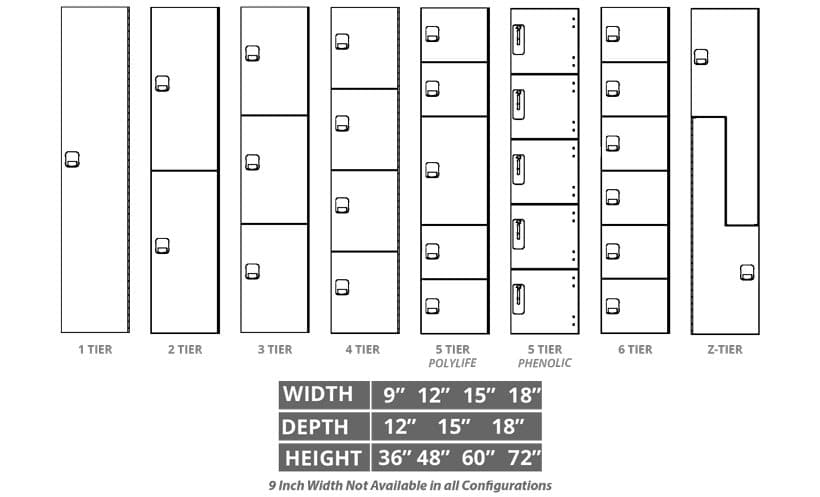
- Configuration: tiers (single, double, triple, box, Z-tier), width, depth and height, and quantity per bank.
- Construction: material and thickness (steel gauge, laminate core, HDPE or phenolic thickness), welded or knock-down for metal lockers.
- Doors: solid, louvered, perforated, or mesh; hinge type; door frame and latch.
- Locks: padlock hasp, built-in combination, keyed, keypad or RFID; master key or control-key access.
- Accessories: number plates, hooks and shelves, sloped tops, closed bases or legs, end panels, filler panels and trim.
- Finish: powder-coat color, laminate or phenolic finish, from the manufacturer's standard range.
- Accessible units: identify which lockers are accessible and how they comply (see Step 5).
Step 4: Part 3 – Execution
- Examination: verify bases, blocking and wall conditions before installing.
- Installation: per the manufacturer's instructions, plumb, level and rigid; anchored to walls or bases so lockers can't tip.
- Adjusting: doors and locks operate freely; touch up damaged finishes.
- Cleaning and protection: remove protective film and debris, and turn over keys and combination charts to the owner.
Step 5: Accessibility and benches
Under the 2010 ADA Standards for Accessible Design, where lockers are provided, at least 5 percent, but no fewer than one of each type, must comply with section 811 (225.2.1). Locker rooms also need a bench complying with 903 (803.4). Specify accessible lockers explicitly and coordinate benches in 10 51 53. Details are in our ADA locker requirements guide.
Locker specification checklist
| Item | What to state | Common miss |
|---|---|---|
| Section | One 10 51 xx section per material | Mixing plastic and metal lockers in one section |
| Manufacturers | Several acceptable names plus substitution procedure | Single sole-source catalog number |
| Configuration | Tiers, sizes, quantities per bank | Quantities only on drawings with no schedule |
| Ventilation | Louvers, perforations or mesh for damp contents | Solid doors in wet or uniform rooms |
| Locks | Type, master keying, who receives keys | Lock type left to submittal |
| Bases and tops | Closed base or legs, sloped top, end and filler panels | No sloped tops or end panels in the bid |
| Accessibility | Number and location of accessible lockers; benches | Accessible units not identified |
| Installation | Anchoring, blocking, bases by others | Blocking not coordinated with framing |
Manufacturer guide specs, CAD details and data sheets are on our tech data page.
FAQ
Frequently asked questions
- What CSI section are lockers in?
- Lockers are in Division 10 under 10 51 00 Lockers: 10 51 13 Metal Lockers, 10 51 16 Wood Lockers, 10 51 23 Plastic-Laminate-Clad Lockers, 10 51 26 Plastic Lockers, 10 51 29 Phenolic Lockers, 10 51 43 Wire Mesh Storage Lockers and 10 51 53 Locker Room Benches.
- Should I write one locker section or several?
- Write one section per locker material. If a project has metal corridor lockers and phenolic locker room lockers, use 10 51 13 and 10 51 29.
- Should a locker spec name one manufacturer?
- Naming several acceptable manufacturers and describing the lockers by configuration and performance keeps bidding competitive. Public projects often require it.
- How many accessible lockers do I need?
- Under the 2010 ADA Standards, at least 5 percent of lockers, but no fewer than one of each type, must comply with section 811 (225.2.1). Confirm local requirements with your code official.
- Can LG2 help write or review a locker spec in Michigan?
- Yes. LG2 supplies and installs lockers from List Industries, Hollman, Columbia Lockers (PSISC), Summit Lockers, GearGrid and The Athletic Edge, and can provide guide specs, data sheets and a review of your section. Call Lucas Reimink at (616) 460-4024 or 616-295-1585.
Sources
- Specialties – Division 10 MasterFormat list. ARCAT.
- Locker Room Benches 10 51 53. Sweets (Dodge Construction Network).
- Plastic Laminate Clad Lockers 10 51 23. Sweets (Dodge Construction Network).
- 2010 ADA Standards for Accessible Design. U.S. Department of Justice.