Employee lockers look simple until you start choosing: how many, how big, assigned or shared, which lock, and whether wet uniforms or PPE will go inside. Get it right and the lockers disappear into the routine. Get it wrong and you end up with padlocks everywhere, lost keys and coats on the floor.
This guide works through the decisions in the order that saves the most rework: who uses the lockers and how, what goes inside, tiers and sizes, material, ventilation, locks, accessibility and installation. LG2 supplies employee lockers from List Industries, Columbia Lockers (PSISC), Summit Lockers, GearGrid, The Athletic Edge, ASI Storage Solutions, Lyon and Hollman, and installs them.
Where employee lockers go
- Break rooms and entrances: coats, bags, lunches and phones for office, retail and back-of-house staff.
- Manufacturing plants and warehouses: street clothes, uniforms, PPE and tools, often in a dedicated locker room.
- Hospitals and clinics: staff lockers for scrubs and personal items, often with day-use lockers for shift workers.
- Fire stations and public safety: turnout gear lockers with open fronts and ventilation.
- Hybrid offices: shared day-use lockers so people without an assigned desk still have a secure spot.
Step 1: Assigned or day-use?
Assigned lockers
- How it works
- Each person keeps the same locker
- Count
- One per employee
- Locks that suit
- Keyed cam, built-in combination, padlock hasp
- Good for
- Plants, fire stations, small offices
Day-use (shared) lockers
- How it works
- Anyone takes a free locker for the shift and clears it at the end
- Count
- Based on peak headcount on site at one time, not total staff
- Locks that suit
- Resettable combination, keypad or RFID/smart locks
- Good for
- Hospitals, shift operations, hybrid offices
Step 2: Tiers and sizes
Tiers are the number of compartments stacked in one locker column. More tiers serve more people in the same wall length; fewer tiers hold longer items.
- Single tier: full-length coats, uniforms, gear.
- Double tier: the common choice for employee locker rooms; room for a coat and a bag.
- Triple tier and up: bags, lunches and small items where space is tight.
- Z-tier (two-person): each person gets a full-height hanging space in an interlocking Z-shaped door, a good fit for uniforms in tight rooms.
- Box lockers and cubbies: phones and valuables.
See the locker tiers and types on our lockers page.
Step 3: Material
Strengths
- Powder-coated steel
- Lowest first cost, noncombustible, easy to ventilate; the workplace standard
- Plastic laminate (PLAM)
- Office and hospitality look in solid colors and woodgrains; quiet
- Solid HDPE plastic
- Won't rust or dent easily; good for wet or washdown areas
- Solid phenolic
- Hard, waterproof, many finishes; fire-rated options
Watch for
- Powder-coated steel
- Can dent; can rust in wet rooms. Galvannealed steel options exist for humid areas
- Plastic laminate (PLAM)
- Keep away from standing water
- Solid HDPE plastic
- Standard HDPE is typically not fire-rated
- Solid phenolic
- Higher first cost
More detail in metal vs. plastic vs. phenolic lockers.
Step 4: Ventilation and door style
- Solid doors with louvers: standard for coats and bags.
- Perforated or ventilated doors: for uniforms, PPE and anything that goes in damp.
- Open-front or mesh lockers: for turnout gear and items that need to dry, and for quick visual checks.
- See-through doors: where contents must be visible for security.
Step 5: Locks and smart lockers
- Padlock hasps: lowest cost; employees supply their own locks.
- Built-in keyed or combination locks: no loose padlocks; a master key or control key lets managers open lockers.
- Keypad and RFID locks: no keys to lose; badge access can tie into the cards employees already carry; resettable for day-use banks.
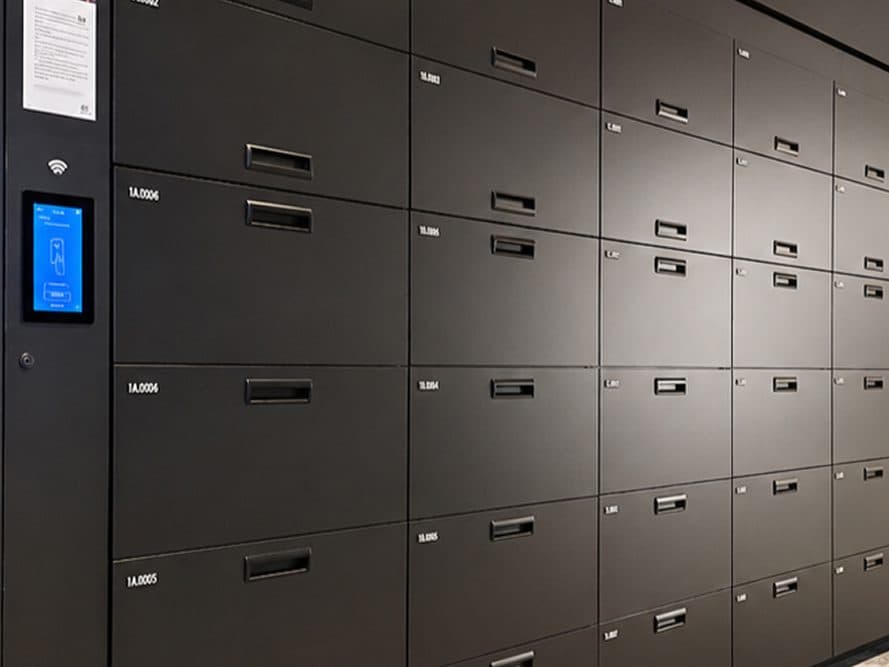
- Smart lockers: cloud-managed lockers such as List Industries LokrIQ, with RFID, mobile and PIN access, for day-use, package or equipment hand-off.
Step 6: Accessibility, benches and installation
- Accessible lockers: where lockers are provided, accessibility standards generally require a share of them to meet reach-range and hardware requirements. Confirm with your code official.
- Benches: plan clear aisle space in front of open doors and room for benches in changing areas.
- Bases and tops: closed bases keep debris out; sloped tops stop items from being stored on top.
- Anchoring: lockers are typically anchored to the wall or floor so they can't tip.
- Delivery and access: check doorways, elevators and the install path before ordering assembled lockers.
LG2 handles the takeoff, submittals, delivery and installation, and offers the brands side by side so you can compare.
Employee locker checklist
- Where the lockers go and who uses them.
- Assigned or day-use, and how many at peak.
- What goes inside: coats, bags, uniforms, PPE, phones.
- Tiers and sizes.
- Material for the room conditions.
- Door style and ventilation.
- Lock type and who holds master access.
- Accessible units, benches, bases and sloped tops.
- Wall length, install path and schedule.
FAQ
Frequently asked questions
- How many employee lockers do I need?
- For assigned lockers, one per employee plus a few spares for growth. For day-use lockers, base the count on the most people on site at the same time, not total headcount.
- What's the best material for employee lockers?
- Powder-coated steel is the workplace standard. Laminate gives an office look, and HDPE plastic or phenolic suit wet or washdown areas.
- What locks are best for workplace lockers?
- Keyed or combination locks suit assigned lockers. Keypad, RFID or smart locks suit shared day-use lockers because they reset cleanly between users and there are no keys to lose.
- Where can I buy employee lockers in Michigan?
- LG2 supplies and installs employee lockers in Michigan and Indiana from List Industries, Columbia Lockers (PSISC), Summit Lockers, GearGrid, The Athletic Edge, ASI Storage Solutions, Lyon and Hollman. For a quote, call Lucas Reimink at (616) 460-4024 or 616-295-1585.
- Do you install lockers too?
- Yes. LG2 handles takeoffs, submittals, delivery and installation.
Sources
- Staff & Workplace Lockers: A Buying Guide. KC Supply.
- Lockers & Personal Storage Buyer's Guide. Find Office Furniture.
- LokrIQ smart lockers and Galvanite lockers. List Industries. As summarized on LG2's lockers pages.